

Orchestrating the immune response against cancer through innovative biomaterials
SymphNode is a biodegradable synthetic lymph node, placed beside a tumor, that recruits and trains the patient’s own T cells to fight cancer.

Backed by investors, funders, and innovation programs






Funded by the NIH’s National Cancer Institute (Fast-Track Phase II SBIR) · Winner of the CASIS Technology in Space Prize · All supporters
Most solid tumors still evade the immune system
Immunotherapy has transformed cancer care, yet most solid tumors remain difficult to treat.
Read about the science- Too few effective T cells. Tumor-reactive T cells are insufficiently activated and expanded.
- A suppressive tumor microenvironment. Inhibitory signals shut down immune cells that do arrive.
- Systemic toxicity and complexity. Body-wide drugs cause side effects, and personalized cell therapies are costly to manufacture.
Instead of engineering immune cells outside the body, we engineer the environment that empowers them inside the body.
Programs immune responses directly inside the patient.
Delivers immune signals where they’re needed, limiting systemic exposure.
Works with the patient’s own immune cells — no patient-specific cell manufacturing.
SymphNode: a synthetic lymph node for cancer immunotherapy
A biodegradable, porous biomaterial scaffold designed to be placed near a solid tumor — potentially during biopsy or surgical removal.
By mimicking key aspects of the body’s natural immune-organizing structures, SymphNode creates a local environment where immune cells are recruited, activated, and expanded.
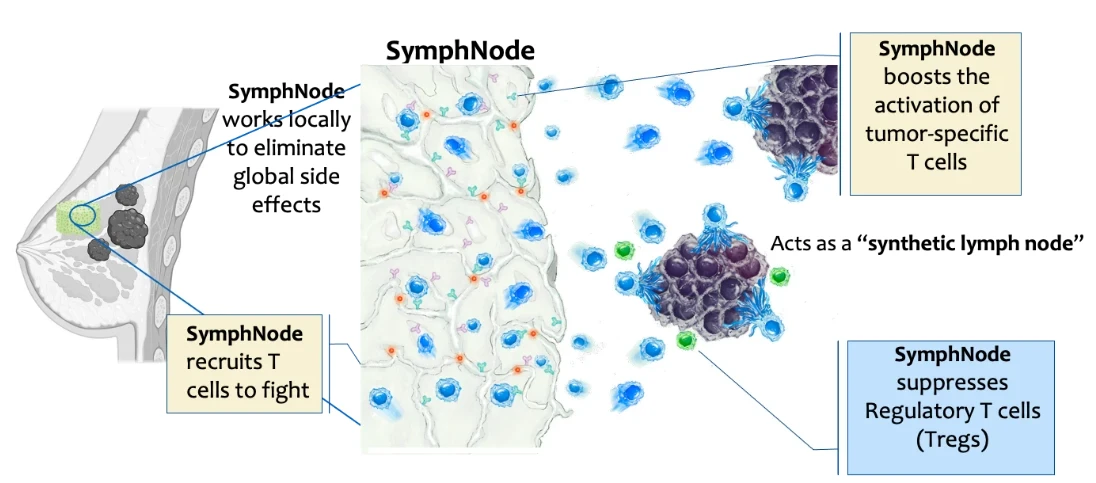
Recruit immune cells
Attracts the patient’s own immune cells into a localized therapeutic environment.
Activate antitumor immunity
Provides immunostimulatory signals that support activation and expansion of tumor-fighting T cells.
Overcome immune suppression
Locally delivered agents counteract inhibitory mechanisms, including regulatory T-cell suppression.
Train the immune response
An artificial immune niche designed to help the body generate effective antitumor responses.
Promote broader protection
The goal: durable, systemic immunity against residual cancer cells, limiting recurrence and metastasis.
Where biomaterials, immunology, and engineering meet
Biomaterial engineering
Biocompatible, biodegradable 3D scaffolds that host immune-cell recruitment and activation.
Localized immunomodulation
Immune-activating and -regulating agents delivered right at the treatment site.
In situ immune programming
Guiding the body’s own immune cells within an engineered environment for stronger responses.
Advancing toward the clinic
SymphNode has shown promising antitumor activity in preclinical cancer models, including evidence of improved survival and reduced metastatic tumor growth.
We’re now advancing preclinical evaluation, safety testing, and manufacturing development, with an initial focus on triple-negative breast cancer and melanoma.
View our pipelineFunded by the National Cancer Institute
Symphony Biosciences is funded by the NIH’s National Cancer Institute through a Fast-Track Phase II SBIR award, and backed by SciFounders and Innovate Alabama.
See all our supportersLet’s build the future of cancer immunotherapy together
We welcome conversations with investors, pharmaceutical partners, and research collaborators.